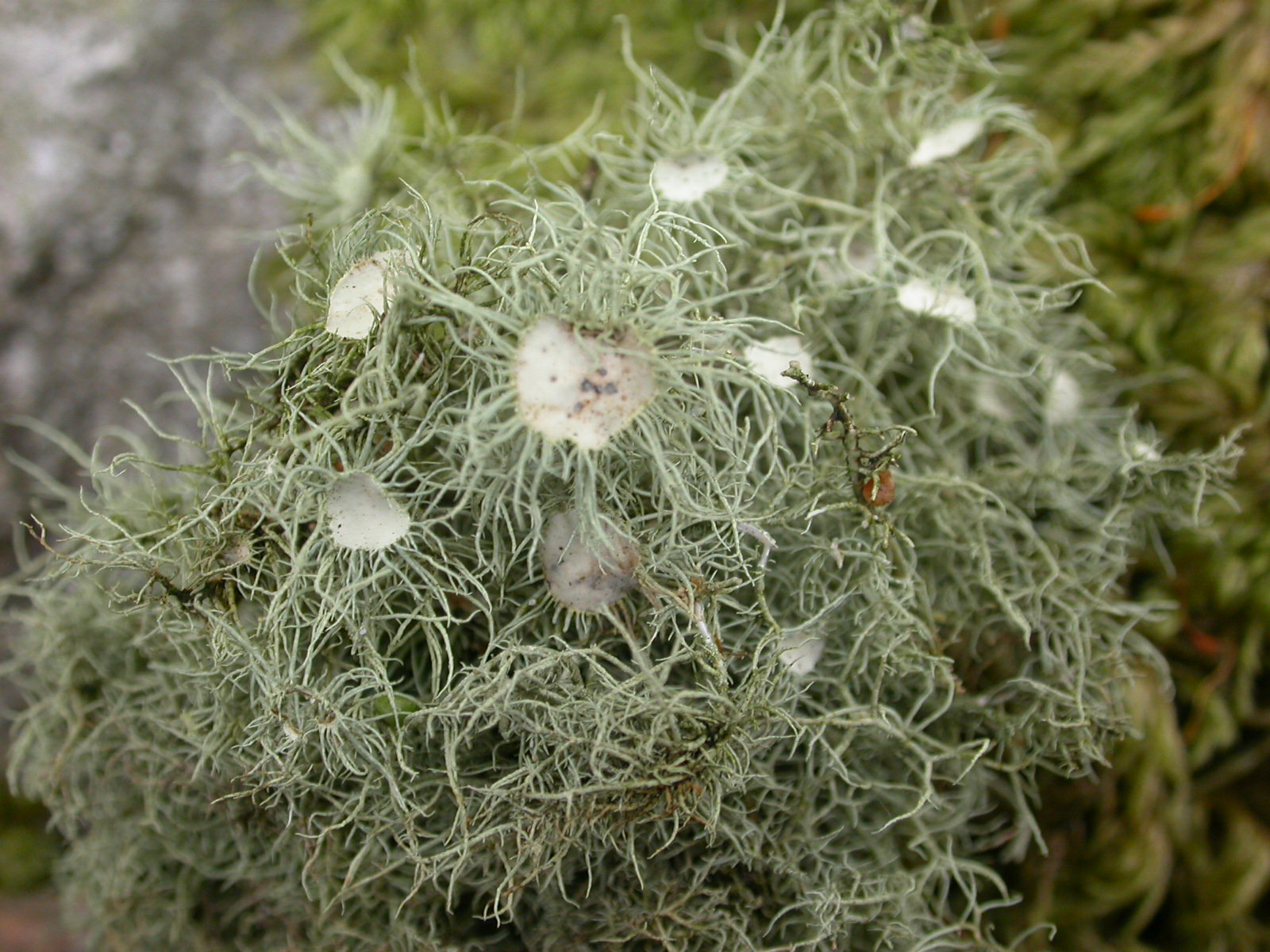
Usnea is a lichen or a cross between an algae and a fungus.Technically it is a fruticose lichen, or a hanging hair lichen. It is sometimes referred to as "old man's beard," and is another of those wild things, that once you have seen, it, you will always remember it. While usnea is not exactly an herb, I am lumping it into that category, because, it is where my own head files it when I think about it, and since my knowledge of fungi, algae, and lichen is very little ,with the exception of usnea, it doesn't get its own category.
Of course , as with almost all of the wild things, I have to give the FDA/USDA, protect us all type of warning. Eating usnea in large ,unrealistic quantities is NOT recommended, as it can cause liver failure. Several years back, it was found that the usnic acid in the usnea, had weight loss qualities. Companies began making a fix-me pill of it and when studies were done, some of the fix-me pill takers had liver issues. Shocking, ain't it? The bottom line, as always, is use common sense with all wild things, do not go nuts and see how your own body reacts to each before deciding to use it in any way in your personal pharmacy.
Usnea is found all over the world and there are thousands of varieties but the Creator of things gave us a very easy to remember way of identifying the sort we can use. Usnea has a white core going through its always round main trunk . If you gently pull it apart, you will see a white core, almost like a very thin strand of elastic, you know the type I mean ladies, the ones that come loose on old style underweenies. Usnea grows mostly in the trees and looks much like Spanish moss, however, when you pull moss apart it will have a black core. Usnea resembles hair or a scruffy looking old mans beard. Sometimes, there is just straight hair and sometimes they have little ,dangly, doodads(as in picture) on the ends of the strands. Different regions have different varieties, learn yours. Usnea grows up in the trees, thankfully, limbs fall making collecting it much easier. It also stays one color all year and does not have much color variation. There are a couple others out there but for safety sake and ease, look for the basic green. Nutrition wise, it is made up of about96% carbohydrates. It's nearly all food and is high in Vitamin C. Usnea is also about half antibiotics which is what makes it such a good wild thing to know.
Medicinally speaking, in Native American traditions Usnea represents the North and maintains the lungs of planet Earth. In those traditions Usnea has a sacred relationship with the trees, helping to protect them against infections. In people it has much the same qualities.It can be used as an antifungal- againsts ringworm, athletes foot and yeast infections. as an antiparasitic it is effective against Trichomonas and Chlamydia in vaginal infections. As an antibacterial it is effective against gram positive bacteria in local or systemic infections. It also works to boost the immune system in cases such as acute and chronic lung infections such as-pleurisy, TB, pneumonia, colds, flu and other types of poor immune function.
Usnea can be dried and ground to a fine powder and applied directly to wounds. It can also be made into a decoction and used with compresses topically, and can be incorporated in to salves, lotions and creams. Again, test a small area before making up a gallon and see how your body deals with it. Some people have a small rash reaction from directly applying it. It can be made in to a tea, however, its healing property do not dissolve well in water and it has next to no flavor. Most often , usnea is tinctured and used in that way. It can also be nibbled on in very small quantities. By small, I mean a pea sized chunk a couple times a day. To eat it in any amount of quantity, one would need to leech off the acids. Surprisingly it does not taste too bad, but is certainly not something I would want to eat an entire bowl of unless I simply had to.
not just for hippies anymore. Where frugality and homesteading meet to create a unique homestead in North Ga.
Monday, September 20, 2010
Wednesday, September 15, 2010
wild edibles-sassafras
Sassafras is one of my favorite wild edibles. Even though one doesn't generally eat it,it has many uses around the homestead as a food/drink, medicinal purposes and as a natural dye(yellowish), so I classify it as an edible.
First and foremost, the FDA has classified sassafras as a carcinogenic, so don't go eating 50 pounds of it in a session or you might get ill. I personally go by the rule, all things in moderation. I know many "foods" that are a carcinogen and they allow the use of them . I will not hop on my soap box but, will allow each as an individual to decide for his/her self.
Sassafras is one of the easiest to identify plants/ trees out in the wild. The leaves make it very easy to pick out as they often times look like mittens and they do not have just one shape of the leaves. One tree can have several leaf shapes on it.
My favorite uses for sassafras are for making teas and in making soda. Tea is made by steeping the bark, leaves or root of the tree in water. In England, the tea is mixed with milk and sugar to make saloop, a morning beverage. I prefer it with just a touch of honey. To make soda or traditional style root beer, make a simple syrup and follow the directions for soda making.
Simple syrup
2 cups of broken-up sassafras twigs or root
2 1/2 cups water
2 1/2 cups sugar
1 teaspoons citric acid or lemon juice
Peel some of the green bark away from the twigs. The bark has most of the flavor. Cover the twigs with the water and bring to a boil. Turn off the heat, cover and let steep overnight. Strain the sassafras tea through a strainer to remove any debris and measure it. You should still have 2 1/2 cups. Add as much sugar as you have tea, stir it to combine and bring it to a boil. Turn off the heat and let it cool. Add the citric acid, 1/2 teaspoon at a time
Store syrup in the fridge in a closed jar. Keeps for up to a year.
Another great use for sassafras is as a thickener in soups, stews and gumbo. Gumbo would not be traditional gumbo without using file. To make, simply dry the leaves of the sassafras and crush or grind. Add it to your recipe as the thickening agent rather than a flour or corn starch thickener.
Medicinally, sassafras is said to have value as a stimulant, pain reliever, astringent and treatment for rheumatism. Skin problems may be bathed in an infusion from the leaves. . It is said that chewing on the bark may help break the tobacco habit, however, the FDA says it isn't good for you and well... you know. I have known a few folks that have used the twig chewing to aid them in breaking the nicotine habit and they have not died from cancer.
Here is another recipe that I have not tried, but thought I would include it since it sounds good. I am going to make my own version of it here on the homestead soon, replacing what I have on hand for what I do not have in the recipe.
Sassafras peanut sauce
2 tbs. peanut oil
2 red onions, chopped
3 large cloves of garlic, chopped
1 cup toasted peanuts, finely chopped
1 cup coconut milk
1/2 cup water
3 tbs. lime juice
1/2 tsp. sassafras root bark (cambium) or cinnamon, ground
1/2 tsp. salt
1/4 tsp. liquid stevia
Saute the onions and garlic in the peanut oil 10 minutes. Add the remaining ingredients, bring to a boil, reduce the heat to low, and simmer 10 minutes.
Puree in a blender or food processor if you prefer a smoother sauce.Serve hot or at room temperature. You can cook vegetables or tofu in this sauce. Serve over rice or pasta.
Here is another link that has some jellies, mead and candies using sassafras. http://www.southernangel.com/food/sassafras.html
Tuesday, September 14, 2010
sun dried tomatoes
I am still getting a ton of what are supposed to be cherry and grape tomatoes, but since it has been so dry here they are more like currant sized fruit, rather than grapes or cherries. While this makes them easy to use in salads or to just pop in your mouth, finding any other use for them has been difficult.
A few weeks back, I decided to see how well they would dehydrate in the solar dehydrator so that I could then use them in soups and stews or grind them into a powder to make quick tomato paste. They seem to dry quite well although they do take a bit of time, well quite a bit of time. Since I have a dash of hippie in me, I try to make or take short cuts when ever I can to save myself a bit of work. This means I leave them whole to dry rather than trying to cut those teeny tiny buggers in half. Besides, I might could chop my finger off attempting to do such a thing. On nice, dry sunny days, it is taking about 3 days to dehydrate them to proper dryness. If I cut them in half, it easily takes a day off the drying time but I am in no rush, and why rush a good thing.
While I use both our solar oven and our solar dryer, you do not have to have anything but a screen to set them on, the sun, low humidity, and time. At night I just cover them up with a tarp or bring the screens they are sitting on in the shack to keep the dew off.
To make quick tomato paste, I simply grind the tomatoes in to a powder and add a bit of water to make a quick paste of them. It works great for recipes where you do not need an entire can of paste and when you are cooking for just two people, that is the majority of the time. I also like to grind the dried tomatoes up somewhat small and add them to salad dressings , they really add some great flavor and zing to anything you put them in.
A few weeks back, I decided to see how well they would dehydrate in the solar dehydrator so that I could then use them in soups and stews or grind them into a powder to make quick tomato paste. They seem to dry quite well although they do take a bit of time, well quite a bit of time. Since I have a dash of hippie in me, I try to make or take short cuts when ever I can to save myself a bit of work. This means I leave them whole to dry rather than trying to cut those teeny tiny buggers in half. Besides, I might could chop my finger off attempting to do such a thing. On nice, dry sunny days, it is taking about 3 days to dehydrate them to proper dryness. If I cut them in half, it easily takes a day off the drying time but I am in no rush, and why rush a good thing.
While I use both our solar oven and our solar dryer, you do not have to have anything but a screen to set them on, the sun, low humidity, and time. At night I just cover them up with a tarp or bring the screens they are sitting on in the shack to keep the dew off.
To make quick tomato paste, I simply grind the tomatoes in to a powder and add a bit of water to make a quick paste of them. It works great for recipes where you do not need an entire can of paste and when you are cooking for just two people, that is the majority of the time. I also like to grind the dried tomatoes up somewhat small and add them to salad dressings , they really add some great flavor and zing to anything you put them in.
Subscribe to:
Posts (Atom)


