Brrr, the nights are still so cool round these parts. Absolutely gorgeous days in the low 70s but nights still routinely below 40. I must keep reminding my self that it is only the 12th of April, I guess because of the nice weather I keep thinking it should be warmer nights. Then again when the warmer nights do get here I will most assuredly complain about that as well. I am a farmer, always have been n always will be so will always complain about the weather, its like a second job.
I have now kicked all plants but the tobacco babies and the indoor tomato out to the balcony to live a while. If I can figure out how to get big momma mater out there she will also be set out there. This way if it gets too cold at night I can slide them all back inside without too much hassle. Speaking of big momma mater, I will take cuttings from her this week and begin rooting them for transplant to the gardens.
On my garden walk about yesterday I noticed that all but one plant of my taters are now up. Even my experimental tiny pieces that I cut from good potatoes are up and honestly I am quite amazed. Those tiny pieces were shriveled down to all but nothing by the time I actually got them in the ground.It will be interesting to see how well they grow and produce. If this works, I will never do potatoes like we have been taught to again as it is a giant waste of money on many levels. My taters I planted way back when in the GH are also up now. I thought my little vole/ mouse had stolen them and presumed they were dead but I noticed them the other day while harvesting collards and they are about 4 inches tall.
The onions n peas are really starting to look pretty in their growing beds or at least I think they are. I absolutely love seeing plants come alive and change my scenery on a daily basis. Each day I walk out there something is a bit different and the more it greens up and starts producing the more I enjoy it. We built the peas a little tower to climb on yesterday. They are not a climbing variety and only grow to about 34 inches but I would like to keep them off the ground if I can as it makes my life much easier for picking veg later on.. Trying to reach down into a bed that is on a hill can be dangerous work especially when you are like me n wobbly already. One good roll and I would be a 1/4 mile away.
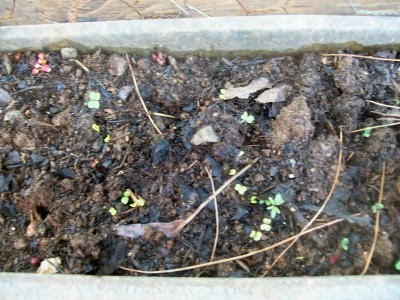
The gutter garden is sprouting nicely and so long as I give it one coffee canister of water daily it stays moist enough to do well. I would really like to find a few more lengths of gutter and make a wall of them on the chicken run. Not only would it look pretty but it would block some of the summer sun from the chicken run and I think the chooks would like it too, I know if I lived in there I would appreciate it.
I found this volunteer squash too!
All of the over wintered plantings have now bolted. When I notice them starting to bolt, I generally take one more good harvest from the plant, remove as much greenery as I can and allow the plant to concentrate on making seed. I do not know if it helps in any way but it doesn't seem to harm and I can usually get a meal or two out of the picking and critters get nice treats. I also top all of my onions while they grow, leaving only about 4 inches of green above ground. I generally cut them down two or three times and then let them grow out until harvest time. Again I do not know if it helps the onion to produce larger bulbs or not but I get a whole lot of green onions to dehydrate and use for the remainder of the year and still get my large onions.
We opened the living room area back up yesterday. I am thinking I will leave the shack arranged as is for now and use the LR as a project, craft, drying , seed saving, storage room and maybe make a window garden in the glass door area. We do not need the space in there to live in and it does make a handy "go to" room for all things homesteading. Today however is being spent cleaning my winter messes up in there and organizing it. It should take me near all day, yuck!
A photo I enjoyed capturing yesterday. I think I followed this feller around for a good half hour before he landed where I could get a decent picture and for a long enough time that I could fumble with the camera and snap this.
not just for hippies anymore. Where frugality and homesteading meet to create a unique homestead in North Ga.
Monday, April 12, 2010
Sunday, April 11, 2010
dehydrating today
Yesterday we pulled the dehydration station out, got her cleaned up and ready to go. Today we are dehydrating for the first time this year. I have some green onions and onion tops in the bottom two trays and a mix of kale, spinach and other greens and a mess of lemon balm in the top level.
For those that have never seen our dehydrator the original post on it is here. The only difference in it now is that we have three trays to dehydrate with instead of just the one.
wild edibles-fiddlehead ferns
Another wild edible that we enjoy in the early spring are fiddlehead ferns. In all actuality they are ostrich ferns but the fiddleheads are the new shoots that come up in very early spring and resemble the end of a fiddle, thus the name.They are low in sodium and cholesterol and are a good source of protein. They provide a good source of antioxidants, Vitamin C and Vitamin A. They also supply valuable nutrients such as: Potassium, Magnesium, Phosphorus and Copper, not too shabby for a free food. When prepared fiddleheads have an almost asparagus like flavor that is slightly nutty and with a little bite. It can be prepared in a myriad of ways, served hot or cold and can be preserved either through freezing or pickling.
Fiddleheads have a relatively short 2-3 week period in April or May to harvest. Once they get too big they become very bitter and no longer good to eat. Like most ferns their habitat tends to be moist and wooded areas and along streams and river banks. They are native to the eastern coast of the US and are easily found from Maine to Florida. Harvesting is done by hand so if you want to purchase them they are quite pricey when found in a retail outlet ($20 a pound or more) and are never as good in taste because of the age factor.
When growing in the wild, the fiddleheads generally grow in clusters of 3-12 fronds and look like the picture shown. They are tightly coiled, bright green and have a sort of hairy flaky chaff on the outside of them. It is light brown in color. Fiddleheads are picked by snapping or cutting of the top of the coiled head. They are best picked with a 2 inch stem or there about and should be no taller than 6 or so inches. At this stage in growth the stem is delicious. As the fern grows, the stem becomes tough and stringy. The earlier and younger the shoot, the more tender the morsels you collect. Fiddleheads that have just emerged are the most tender, but newly emerging fiddleheads are more difficult to clean. Picking these young ferns when they are dry and several inches from the ground greatly reduces the amount of cleaning time.
There are other species of fern out there that have chaff on them that is reddish-purple or white, these are not fiddle heads so avoid them. If ever in doubt with any wild edible, find someone knowledgeable and have them show you in person what to look for. I try and keep the wild edibles I share simple and basic because I myself am self taught and know how confusing learning wild edibles can be with out a hands on mentor.
After harvesting your ferns the chaff needs to be removed. I generally soak them in cold water for a few minutes and then scrape the chaff off with a small knife. With only two of us here this is a quick and simple process although if I was preparing a huge mess of them it would be quite a chore. Some folks just wait til they age a bit and the chaff dries and flakes off. I personally find that the fresher the produce the better tasting, even when it comes to wild edibles.
Fiddleheads must be fully cooked to maintain safety. Because of their habitat many have been flooded by water from the streams in early spring, there is a chance of bacteria or pollutants from the water. For safety and taste reasons after cleaning, cook your fiddle heads for10 minutes in boiling water. They should be firm and hold their shape, yet tender to the bite. From this point on the possibilities for them is endless.
Most of the time, I just add them to our stir fries and mixed veggie dishes. They make a nice addition to any dish when served in that way. They are also good when sauteed up with some onion , bacon, a touch of vinegar and spices. Tonight I am using them in a pasta dish with a very simple topping of bacon, onion, fresh tomatoes, creole spices and cheese.
Here are a few sites that have many recipes of all sorts for fiddleheads, so go on pick ya some, you are sure to find something that perks your taste buds up.
Fiddleheads have a relatively short 2-3 week period in April or May to harvest. Once they get too big they become very bitter and no longer good to eat. Like most ferns their habitat tends to be moist and wooded areas and along streams and river banks. They are native to the eastern coast of the US and are easily found from Maine to Florida. Harvesting is done by hand so if you want to purchase them they are quite pricey when found in a retail outlet ($20 a pound or more) and are never as good in taste because of the age factor.
When growing in the wild, the fiddleheads generally grow in clusters of 3-12 fronds and look like the picture shown. They are tightly coiled, bright green and have a sort of hairy flaky chaff on the outside of them. It is light brown in color. Fiddleheads are picked by snapping or cutting of the top of the coiled head. They are best picked with a 2 inch stem or there about and should be no taller than 6 or so inches. At this stage in growth the stem is delicious. As the fern grows, the stem becomes tough and stringy. The earlier and younger the shoot, the more tender the morsels you collect. Fiddleheads that have just emerged are the most tender, but newly emerging fiddleheads are more difficult to clean. Picking these young ferns when they are dry and several inches from the ground greatly reduces the amount of cleaning time.
There are other species of fern out there that have chaff on them that is reddish-purple or white, these are not fiddle heads so avoid them. If ever in doubt with any wild edible, find someone knowledgeable and have them show you in person what to look for. I try and keep the wild edibles I share simple and basic because I myself am self taught and know how confusing learning wild edibles can be with out a hands on mentor.
After harvesting your ferns the chaff needs to be removed. I generally soak them in cold water for a few minutes and then scrape the chaff off with a small knife. With only two of us here this is a quick and simple process although if I was preparing a huge mess of them it would be quite a chore. Some folks just wait til they age a bit and the chaff dries and flakes off. I personally find that the fresher the produce the better tasting, even when it comes to wild edibles.
Fiddleheads must be fully cooked to maintain safety. Because of their habitat many have been flooded by water from the streams in early spring, there is a chance of bacteria or pollutants from the water. For safety and taste reasons after cleaning, cook your fiddle heads for10 minutes in boiling water. They should be firm and hold their shape, yet tender to the bite. From this point on the possibilities for them is endless.
Most of the time, I just add them to our stir fries and mixed veggie dishes. They make a nice addition to any dish when served in that way. They are also good when sauteed up with some onion , bacon, a touch of vinegar and spices. Tonight I am using them in a pasta dish with a very simple topping of bacon, onion, fresh tomatoes, creole spices and cheese.
Here are a few sites that have many recipes of all sorts for fiddleheads, so go on pick ya some, you are sure to find something that perks your taste buds up.
http://www.umext.maine.edu/onlinepubs/htmpubs/4198.htm
http://gonewengland.about.com/od/fiddleheadsrecipes/Fiddleheads_Recipes_Fiddlehead_Fern_Recipe_Collection.htm
http://allrecipes.com/Recipe/Trout-with-Fiddlehead-Ferns/Detail.aspx
Subscribe to:
Posts (Atom)