Showing posts with label make it. Show all posts

Thursday, August 18, 2011

pallet bench


Manthing was stumbling around the internet last week and ran across this upcycled pallet bench. We both thought it was a cute idea and that we could replicate it even though it did not have any destructions to go along with the photos. Since he is having a slack work week and he needed a project, I suggested he work on it today while I worked on a school paper. It turned out to be another one of those "it's as simple as that" type projects that although it looks quite simple, it aint.

He started with two pallets that were not identical in size which caused the first little stumbling block. This meant the pallets could not just interlock and be portable. This meant that he had to come up with a plan b which was fine as we don't need it to be stored away.

With one pallet he removed the pieces and parts to make it look like the picture below.
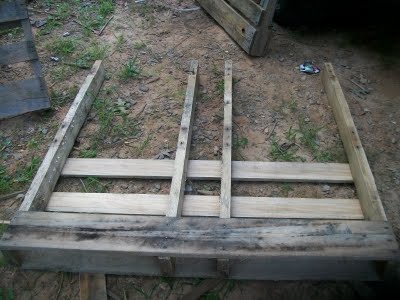
On the second pallet he removed a slat so that the first pallet could slide through.
Next he slid the first pallet through the second to form the bench
Because our bench is not going to be stored away and will be sitting out in the elements he added pressure treated 4x4 blocks under the back legs. He then added a 1x4 to hide the 4x4's and to hold things in place.Next, he cut the front legs so that it would sit level and added a piece of 1x6 to keep the front legs off the ground. Then he screwed the two pallets together where they connected and added in a couple small blocks of wood for extra bracing. To fill the gaps in the pallets he used slats from the pallet that he removed most of them from. To finish it up he sanded it lightly to get any splinters off to protect our butts and where our legs will hang over.
All in all, it is quite comfortable and is plenty big for two people to sit comfortably. Cost was free but for the few screws. The whole process took about 4 hours including a bit of pondering time to figure out how it was going to be done.

Saturday, September 4, 2010

doggie bag

In the past, manthing and I have seen the upcycled tote bags  and thought what a neat idea, and at one point we had good intentions of making them. Unfortunately, it is one of those things, that although we say we will get around to it, we never do.  When he started  the new job, he needed a tote  to haul all his small tools for work but he didn't feel  like going to town to buy an overpriced piece of crap made in China that would last a month and break.

Because he is 1/3 hillbilly,  he decided to  be resourceful and make his own bag. Being 1/3 hippie, he did not want to make handles  and sew them on, and because of the 1/3 white trash in him, he does love his duck tape.  This is his doggie bag that he made and I must say, it works quite well. So well in fact, that I think  he I might just make me 10 or 12 and begin using them for our grocery bags from now on. It isn't like we will stop feeding the dogs anytime soon, so we will always have a supply of them  and the duck tape is only a few bucks a roll, so theoretically, he I could make  a few dozen  for a couple bucks.  We could get all fancy  and get the red or blue tape and make it match the doggie bag too. Hey, I wonder if we could get the dog food company to push this  and get a life time supply of dog food for nothing because of our  manthing's brilliance.
 Anywho, this is the bag and I think it is self explanatory how he made it. Just in case though, all he did is cut it off at the height he wanted. He then took a razor knife and cut his handle holes in. The last step was to  tape off all the cut areas and wallah, a doggie bag .

Monday, July 26, 2010

hillbilly air conditioner

Although we live in Georgia,we have no central air conditioner or even a room air conditioner. Most of the time our single fan keeps us cool enough to be comfortable but  over the last few weeks we have been having quite a heat wave. Temperatures have been in the mid nineties with high humidity so the heat index has been  at 100 or more  for several days now and is something we are not all that accustomed to.  If we were employed perhaps we would just go out and buy an air conditioner but were aren't so we have to make do with what we have on hand in order to try and cool ourselves down a bit. In our internet travels over the last couple years we have run across the hillbilly or redneck air conditioners that folks have made so we decided to give it a whirl and see how they work.

This is not green or exactly eco friendly, but it is using what we had on hand, recycling it  and making the appliances that we have already sucking juice work a bit more  to earn their keep. This is also not anything like an air conditioner and will not cool your home down like an air conditioner, but it will bring the temps down to a more tolerable level.

Rather than make a whole new tutorial on this, I will refer you to the tutorial that we used for our project. We  mostly followed this, but we used an old water cooler instead of a foam one and we used an  inline diaphragm  pump from the old trailer we scrapped instead of the one like they use in the tutorial. We  made the copper tubing able to be untied from the fan so that we can move the fan  and use it as  needed. Lastly, we hooked the pump up to a battery rather than electricity because we could.

This cost us zero dollars to make and took about an hour of time when it was all said and done.  The other day after setting it all up we managed to cool the room by five degrees in about a half hour. The one down side that we have seen to it is that the ice melts rather quickly  and because of the style of pump we used we can only run it for short periods at a time. No matter,  it has served its purpose and it has been fun to experiment with.

We made ours with a box fan complete with dust, but we have seen them  on all types of grated fans.
We then took a coil of copper, already coiled even and attached it to the front of the fan. Most people use zip ties to do this but we wanted to be able to use the fan as a fan so we used yarn to attach it. Most tutorials we have seen use copper for the coil. It keeps the cold better than other tubing would although we think that most any tubing could work in a pinch.
We drilled holes through the top of our water cooler so that we could  set the pump on top and run the tubing through for the water intake and out put. Most folks use a submersible pump  that  actually goes in the  cooler itself.
Because of the the pump that  we used, we put  an old piece of carpet on top of the cooler  so that when running it would cut the noise level and so the pump wouldn't rattle itself off the top of the cooler. Next simply put water and ice in  and put a towel or something under the fan  for any condensation and  chill out.

Monday, May 10, 2010

I am so cheap-old fan/ wick garden

A while  back I posted about  wanting to make a garden of tin cans and old clothes.   The other day the fan in the GH crapped out and while trying to decide what to do with it I had an idea! Scary ain't it? I could take the innards out,  put the grate back on and make a  small wick garden of it.

It was really simple to make and took all of about 10 minutes to put together or would that be deconstruct and put together. It cost absolutely nothing to make as the bed is the fan box, liner and wick were old tarp and  rags, the cans  have been sitting here waiting to be recycled for years as was the bleach bottle waterer   and the compost  and leaves were from here. Even the seeds were from some I saved. This would make a really good project with a group of kids as it doesn't take much time yet  can teach them so much.

To make it  all  I did was take the motor and blades out of the fan and replace one grate . I lined the bottom with an old piece of tarp and then laid the rags on top. I tossed some bent up old cans in and then  drilled one hole in the bottom of the bleach bottle and  placed it in one corner of the bed.  I then  spread a thin layer of compost and soil,  mulched with leaves and planted some basil seeds. To finish it off I filled the bleach container with water. If I wanted to pretty it up I suppose I could paint it with something cute.

Sunday, April 4, 2010

around the homestead-gutter garden

A few months back I posted a couple of great ideas for gardening in limited spaces. One of those I posted was  gutter gardens. I thought it was a really neat idea  and decided that I needed to have me one. When we remodeled the chicken coop over the winter I knew immediately where I wanted to  hang my gutter garden project that I was eventually going to have and today  I have  my gutter garden planted.

I should have taken a photo of the pieces of gutter we had to use. One section was smashed flat and the other was sliced,  had a few rust issues and was so loppy jawed it wasn't funny. Again we beat and banged, yes I can include myself today, chopped, sliced and hammered and  we now have a fully functioning  12 foot long section of garden area on the chicken run fence line.
 All we did was splice the two pieces of gutter,  fabricate  a couple end pieces (remind me to NEVER choose this as a career), attach the gutter hangers to the wood rail on the chicken run and add a couple wires for good measure. Cost to us was nothing  as we had the scraps lying around and it took about an hour n a half from start to finish. I then filled it with  soil, some compost and planted it out with  3 types of lettuce and some spinach. The area it is located in will be somewhat shaded once the trees come in to their leaves and I am hoping to prolong our lettuce and greens season.  To go with the theme of cheap garden, the seeds were   from DG and cost a total of a buck.  We have  discussed putting a little walk way on the inside of the chicken run   at the level of the gutter garden and making a chicken  buffet of sorts, I think they would love it!

If someone had to go out and purchase the gutters new this could be a bit costly to  set up especially if you were running more than one  run of gutter. At the same time gutters are hung every day all over the world so  finding some used ones shouldn't be too difficult. With craigs list and such these days I imagine in an urban or suburban area, these could be readily found.

Saturday, April 3, 2010

around the homestead-compost bin

After the fun of trying to get compost to the front garden beds a couple weeks back we decided  that we needed to  have us a compost bin  closer to those beds. It would also give us a bin closer to the house  for  the non critter household scraps. After pondering a bit on where to put it  we decided that it would go  down front between the wall of flowers and the largest bed. There were only three viable options  and the other two choices were a further walk  and would have taken some rearranging of the earth to make it a some what level  space and usable.

This compost area is much smaller than the one down by the critters and is very simply put together using some fencing and old tent posts. You would be amazed at just how useful the sections of old tents can be on a homestead. Stakes and fence posts are just a couple examples.This bin measures about 4 foot across is circular and is about 3 foot deep.

This compost area took about 5 minutes to set up, cost absolutely nothing to make and will  save us many sore muscles in the future.

around the homestead-rain barrel

We have used  rain catchment systems here on the homestead for many years. It is in fact our only water source on the property. We have no well and  are not on a municipal supply. Unfortunately the main supply of water, the cistern, is a couple hundred feet away from  most everything else on the homestead. This means either carrying buckets of water huge distances to the critters as well as the greenhouse and a majority of the gardens or running hoses all that way.

The last several years we have used a simple rain barrel placed at the end of the awning of the 5th wheel trailer to catch the rain for critter and garden use. This year however the old trailer is being dismantled which meant that we would be losing this water supply. After a bit of pondering  what we were going to do we came up with  our solution. We would simply move our harvesting station to the back side of the chicken coop and run a gutter along to catch the rain  off the coop roof.

It certainly ain't pretty but it was simple to rig up  and it will completely functional. We had most of the materials laying around the homestead and we manthing simply cut, chopped, bent and modified  the various materials in to what we he needed. If we had had one single long piece of gutter we would have eliminated 95% of the work, but we didn't. Total cost of the project was 4 bucks  for a box of screws  that we probably didn't really need.  It took  about three hours  of time to  take down the old  and put together the  new setup. Time saved  and the convenience factor  by having just a 50 gallon  barrel there  is immeasurable.  If we do happen to run the barrel dry we can still run a hose from the main cistern  to fill the tank. At the number  of critters we are at currently and  so long as we have normal or average rainfall the 50 gallons  serves us perfectly.

Friday, March 12, 2010

lacto fermented soda-part 2

Once the culture for the soda is made, it is time to make the syrup. The recipe I learned with was ginger beer but a syrup can be made from any number of things, the choice is entirely up to you. No matter what flavor you make the syrup is made pretty much the same.

Here are the second steps of the process in video format.


you will need a one gallon, preferably glass container to mix your soda in

syrup recipe
 in a kettle combine
2 qts water
2 1/2 oz of fresh grated ginger (bout the size of a thumb)
Bring to a boil and simmer for 30 minutes.Shut off heat.
add
1 1/2 cup sugar
2 tbsp lemon juice
Stir until dissolved. Strain through cheese cloth into the gallon jar. Add 6 cups of water to jar and let cool until room temperature. Strain 1 cup of starter and add to syrup mixture. Fill remainder of jar with water Stir . Cover with cheesecloth and let sit on counter for 3 days up to 10 days. Stir twice daily. The longer you ferment it the more alcohol it will make and less sweet it will be. There will be bubbles on top of your soda.

Bottle your soda into any container that will close tight. ( glass soda resealable bottles, old soda plastic bottles etc. The smaller the jar the better it will retain its fizz) Fill bottle to about 2 inches from top, cap tightly and allow to continue to ferment for 3 more days. Chill and serve. Fruit sodas will most likely need to be chilled after a day or two as they ferment more rapidly.

The first few times I made our soda, I made it in any container that sealed and it worked. Just recently however I acquired a couple cases of beer bottles, a capper and several thousands caps. When I bottle the batch I currently have  going I will make a post on that system. Its pretty neat and can't wait to try it.


Friday, February 26, 2010

I am so cheap- seed envelopes

This morning I needed to  bundle up a seed trade package and didn't have any plastic bags that I normally use for them. Looking on my messy desk I saw some old envelopes  just laying there, I believe they were from Christmas cards that were sent to us. I have been meaning to copy the addresses  into  my address book since we received them but there they sat in a muddled heap with phone numbers, notes, lists and thoughts scribbled on them in  many colors of ink, marker and colored pencil.

I at this moment decided that I had my seed envelopes. All I needed to do was get to chopping and with a tiny bit of tape I could have several envelopes. I could also get my addresses, phone numbers, thoughts, comments and lists all put in the proper locations and my desk  would get cleaner too. Instead of kill two birds with one stone I was going to kill me four.

Unfortunately, my excitement of  making my own  seed envelopes over took my common sense and I just started chopping away,  turning things inside out and taping.  Satisfied with my  new,  upcycled seed packets  I then  placed all the seeds for the various packages I was preparing in  the envelopes, sealed them all up, labeled them  and put them in their various envelopes.   What I failed to  do was  write anything down  that was written on any of the envelopes so if any of you  get my daughters phone number  or  one of my to do lists  on the inside of your seed packet, please email  me the information.

Kidding, really. That was all a lie,  but I did make my own seed packets from junk mail envelopes this morning. One envelope with a small  see through window will make 7 small seed packets. I chopped them to the size I wanted then  just used some cheap scotch style tape for the  seams.  They sure ain't pretty but they worked great. Heck I bet if you had a glue stick  you could make them even cheaper than by using the tape and if you had a child around they would love to decorate them for you.

Thursday, January 21, 2010

basement cold rooms

Way back in the days of old before the advent of modern grocery stores every home had a root cellar or something similar to store their crops in through the winter months. If they didnt have a good food supply put back then they were going to go hungry part of the year as there was not a grocery store on every corner. Even in the deep south cold storage areas are very important. Even though they cant normally keep the food at optimum storage temperatures, it will keep the food 20 or so degrees cooler than the out door temps therefore increasing the span of edibility.

In many places in modern times, digging an old time root cellar simply cant be done but there are alternative solutions that work just as well. In this thread we shall explore basement cold rooms or cellars. Most tutorials and plans for the basement cold rooms tend to be all about the same.

This first plan is from an ol feller on another board. Heis  a cantankerous grumpy bugger but he has some very nice tutorials on his site. Maneuvering the site however is an issue so I will post his words with a link to the pictures detailing what he did

Cold Room in Basement.
http://www.durgan.org/URL/?WVRGE 30 August 2009 Cold Room Construction

Cold room construction in the utility room in the basement. Purpose is for storing garden produce. Potatoes, carrots, brussels sprouts, beets, etc.

This is the cold room built in my basement. Space was at a premium so I did the the best with what was available.

The floor space is 18 square feet, and 80 inches in height. A four inch outside air vent was installed. The hole was cut with a rental tool. The one plug in the room is split and the light is switched from outside. Paneling was construction grade spruce 5/8 plywood. Insulation of the inside wall is R14, and a vapor barrier was installed on top of this insulation, then covered with5/8 plywood. The roof was insulated in the same manner.

Tables are plastic, the same as I use in my greenhouse. Vegetables will be stored in the common plastic milk containers. The air inlet will be controlled by stuffing a rag in the inlet if it get too cold. The exhaust went is four inches diameter, and is in the roof of the structure. Humidity will be controlled with a pan of water, if necessary.

Time to build about 48 man hours. Started 25 August and finished on 30 August 2009.Cost $565.42 I had some help for about 16 hours.


Here are the pics of how he organized it http://www.durgan.org/URL/?NKLSD

Keep Produce Fresh In Cold, Moist Air
If you live in an area where fall and winter temperatures remain near freezing and fluctuate very little, you can store root vegetables, apples, and pears in a wide variety of insulated structures and containers. These range from a simple mound in the garden to a full-fledged root cellar. In each case, the storage unit must maintain temperatures in the 30 degrees F to 40 degrees F range with humidity between 80 and 90 percent. The high moisture content of the air prevents shriveling due to loss of water by evaporation. An old-fashioned, unheated basement is an ideal spot for a root cellar, but a modern basement can be used if a northerly corner is available.
Different vegetables can be stored together in a single container, but fruits should never be stored with vegetables nor should different fruits be stored together.

An 8-foot by 10-foot root cellar will accommodate 60 bushels of produce. Indoor root cellars are the most convenient to use and easiest to build. Try to use a northeast or northwest corner of your basement that has at least one outside wall and id as far as possible from your oil burner or other heat source. One north-facing window is desirable for ventilation. The interior walls of the root cellar should be constructed of wood, and if the basement is heated, they should be insulated. The precise amount of insulation needed depends on the average basement temperature, but standard 4-inch-thick fiberglass batting with a foil or plastic vapor barrier should be more than adequate. Install the insulation with the barrier against the wood. Add an insulated door and fit the window with shades to block out light. To keep humidity high, spread 3 inches of gravel on the floor and sprinkle it occasionally with water. You can also maintain humidity by storing the produce in a closed container, such as a metal can lined with paper.

This text and picture were taken from a 1981 edition of a Reader's Digest book, Back To Basics.

Image

following are a few more links to basement cold cellars.
http://www.ehow.com/how_2085550_make-ba ... ellar.html

http://www.motherearthnews.com/Do-It-Yo ... ellar.aspx

simple in-ground or mound vegetable storage

There are several methods of in-ground veggie storage ranging in very simple to quite extravagant if there is such a thing in the root cellaring world.

One of the easiest methods is- At the end of the growing season, bend over the tops so that root energy will not continue to be sent to them. Do not cut the tops off as this will provide entry for bacteria and insects which may destroy the root before you come back for it. Cover the rows with a mulch of straw, hay, or cut weeds and long grass so that the ground is less likely to freeze.

The next easiest option is to make a simple dug out pit. Roots, tubers, and bulb vegetables require little effort to store. Some vegetables - including beets, carrots, parsnips, rutabagas, and turnips - Cover with a 1-2 foot (30-60 cm) layer of mulch such as straw or hay, which will trap air and won't become saturated with water, an easy way of storing vegetables. You can also use wood chips or leaves if you remove them before they decompose in the spring.

Here is a simple cone pit-A cone-shaped pit can be constructed to store small amounts of vegetables such as potatoes, carrots, beets turnips, salsify, parsnips, and cabbage Such structures can also be used for storing winter apples and pears.(fruit should not be stored with veg.)

Image


Another version of a dug out pit uses either a barrel baskets garbage cans and old tubs of some sort. The picture below pretty much explains how to make any of these . Simply modify as needed.

Image
Image

The upside of in-ground storage is that it's easy. The down side is Produce stored in this type of manner must all be removed once the pit is opened during cold weather, particularly when the soil is frozen. For this reason, it is better to construct several small pits rather than one large one. When constructing small pits, place a small quantity of several different vegetables in each pit. Then you need open only one pit to get a variety of vegetables. When several vegetables are stored in the same pit, separate them with straws or leaves.

Here is yet another method of a storage pit. Seems like an awful lot of work for what it is but neat none the less.

A storage mound is yet another simple storage method for crops. A storage mound is similar to the unlined pit but above ground. It is used where groundwater is a problem or where only a short storage period under mild temperatures is anticipated. The vegetables are piled on a layer of straw on top of the ground. The mound then is covered with a layer of straw that is held in place by a layer of soil. The mound usually contains one or two bushels of mixed roots, so when the mounds are removed, all the produce can be taken into the house.

Image

Saturday, January 16, 2010

chemical free home made pesticides

Often times our gardens get little creepy, crawly and gross pests. Sure, we could run out and spend a fist full of money and come home and spray our foods with chemicals and lord knows what else, however, more often than not there simply is no reason to. With a few ingredients from our our kitchens and gardens we can  make  some very good pesticides and they are completely chemical free. More often than not these simple easy to make home remedies can keep your garden pest free. Here are a few of my favorite recipes  for some of the most common  pests we encounter in our gardens.

For recipes that require liquid dish detergent, use the basic stuff–nothing fancy with added bleach, nothing concentrated and no special antibacterial formulas. You can also substitute with a gentler liquid soap such as liquid castile or a perfume free, gentle liquid hand soap.

As with all pesticides, take care when applying to food bearing plants, handling and storage of the pesticide. Make sure to wash all produce well before consuming.


Rhubarb Leaf Pesticide Spray
1 cup rhubarb leaves
6.5 cups water
1 tsp liquid dish detergent or soap flakes

Cover rhubarb leaves with water and bring to a boil. Boil for 20 minutes then remove from heat and cool. Strain then add 1/4 cup liquid dish detergent. Spray on plants. Good for aphids, june beetles, spider mites, thrips. Rhubarb leaves are poisonous, take care when preparing and handling.

Garlic, Peppers & Onion Insecticide
2 hot peppers
1 large onion
1 whole bulb of garlic
1/4 cup water

Toss in the food processor and add water, blend until a mash is made. Cover mash with 1 gallon hot (not boiling) water and let stand 24 hours. Strain. Spray on roses, azaleas, vegetables to kill bug infestations. Bury mash in ground where bugs are heaviest. Good for thrips, aphids, grasshoppers, chewing and sucking insects.

Tomato Leaves Spray

Crush leaves from a tomato plant and soak in water for a couple days. Strain then spray. Good for grasshopper and white fly control. Tomato leaves are poisonous, take care when preparing and handling.

Basil Tea Spray
4 cups water
1 cup fresh basil (or 2 TBS dried)
1 tsp liquid dish detergent

Bring water to a boil then add basil. Remove from heat, cover and steep until cool. Strain. Mix in the liquid detergent then spray on plants. Good for aphids.

Salt Spray
2 TBS salt
1.5 gallons warm water

Mix salt and water to dissolve, allow to cool to room temperature. Use for spider mites, caterpillars, cabbage worms and chewing insects.

Japanese Beetle Bait Trap
2 cups water
1 mashed banana
1/2 cup sugar
1/2 cup wine
1/2 tsp yeast

Mix ingredients together and put in an old margarine container, cover with lid and set container out in the hot sun for a day. The next day, remove lid and set in garden where the beetles have been spotted (use a shallow container).

Peppermint Tea
1 TBS peppermint essential oil (can also use an infusion made with mint leaves, increase amount to 1 cup infusion)
1 quart water

Mix together and use as an insect spray (good for ants).

Horticultural Oil Spray
1 TBS vegetable oil
1 tsp liquid dish detergent
2 cups water

Fill a spray bottle with the ingredients then shake to mix.

Citrus Rinds as Slug Traps. If you don't have beer in the house, but you do have oranges, grapefruits, or lemons, give this a try. Cut a grapefruit in half and scoop out the flesh, leaving the empty rind. You can eat the grapefruit of course. Place the rind, upside-down (skin up, pith down), in your garden wherever you've noticed slug damage. Let the rind sit overnight.The following morning, lift the rind up. Slugs will have congregated on the underside of the rind. Dispose of them as you see fit. (Chickens like them )Replace the rind and repeat until you stop catching slugs or you stop seeing damage.

Newspaper Earwig Traps work well for reducing the population of these sometimes-pesky insects. Simply take a section of newspaper, slightly dampen it, and roll it up. Place it on the ground in your garden wherever you have seen earwigs. You can also do this near your newly planted seedlings to trap any earwigs before they damage your plants. Let the newspaper sit over night. Earwigs are most active after dark, so they'll find their way to your trap then.In the morning, it's time to check the traps. The first thing you need to do is get a bucket of soapy water—dish soap works perfectly. Take the bucket to where your traps are.Pick up your newspaper trap and shake it out over the bucket of soapy water. You can also unroll it slightly to jar the earwigs loose. The earwigs will fall into the soapy water, and die. You can dump the water, with earwigs, into your compost pile.It's not a bad idea to set your traps for a few days, or until you are finding very few if any earwigs in them. Once you've reached that point, your earwig problem is solved!

Milk for Powdery Mildew. The milk works just as well as toxic fungicides at preventing the growth of powdery mildew. This mixture will need to be reapplied regularly, but it works wonderfully. Mix nine parts water to one part milk and spray.

Baking Soda Spray
for Powdery Mildew is a tried-and-true method for preventing powdery mildew. It needs to be applied weekly, but if you have a problem with mildew in your garden, it will be well worth the time. Simply combine one tablespoon of baking soda, one tablespoon of vegetable oil, one tablespoon of dish soap and one gallon of water and spray it on the foliage of susceptible plants.Baking soda spray works because the baking soda disrupts fungal spores, preventing them from germinating. The oil and soap help the mixture stick to plant leaves.

Coffee Cream and Sugar when you make coffee (organic of course) make a second batch for yourself add a dash of milk (1 cup per gallon is enough) and a tablespoon of sugar per gallon of coffee you make. The coffee provide the correct ph while the milk the bacteria and calcium and the sugar helps raise the bric level of the plant.

Wednesday, January 13, 2010

Monday, January 4, 2010

monday's mountain musings

I kind of enjoy playing with the movie makers. They take a fair bit of time and can be quite frustrating but I like the end result Over the last few days I have made a couple more besides the cabin video


Thursday, December 31, 2009

home made all purpose cleaners

Many like to start the new year off with a nice clean house and many have goals or resolutions to begin using more earth / people/home friendly cleaners in the household . So, in honor of the resolvers and cleaners....

Here are several all purpose home made cleaners. Try one or all and see which one you like the best. All work as good or better than anything you can buy commercially and are much better for you health wise than the chemical laden, toxic products on the market. If you are an allergy or asthma suffers one of the first things you should do is eliminate the chemical based cleaners from your home.

You can also save money by mixing up your own cleaning solutions, these products can all be made for literally pennies rather than several dollars. for those that like to have a stock pile or prep, it takes much less space to store the ingredients to make hundred of gallon of home made cleaner than it does to store all the pre-made products.

Non-Toxic All Purpose Cleaner
1/2 water or colloidal silver
1/2 vinegar
4 tablespoons lemon juice
10-20 drops tea tree oil
spray bottle
Combine all ingredients in a plastic spray bottle. Has a tea tree/vinegar smell. (If you don't like the smell of tea tree oil, try lavender or citrus.) Shake your to mix. Use this all purpose cleaner anywhere as needed. Non-toxic and organic so it is safe for daily use on door knobs and toilet handles, switch plate covers etc.

Amazing All Purpose Cleaner
1 teaspoon borax
2 tablespoons vinegar or lemon juice
1/2 teaspoon washing soda
1/2 teaspoon vegetable-based detergent (castile soap)
2 cups very hot water
Combine all ingredients in a plastic spray bottle.Shake your new homemade all purpose cleaner to mix. Use anywhere as needed. Strong enough to wipe out germs and viruses. Use daily on door knobs and toilet handles, especially when a family member is sick.

all purpose cleaner
3 tbsp. vinegar
1/2 tsp. washing soda
1/2 tsp. vegetable oil based liquid soap (castile)
2 cups hot water
Mix ingredients in spray bottle or bucket. Apply and wipe clean.

Homemade Spray Cleaner Recipe

1 cup white vinegar
1 cup water
Mix in a sprayer bottle

In the kitchen, use vinegar-and-water spray to clean counter tops, lightly soiled range surfaces and back splash areas. Works great on stainless steel surfaces, no streaks.

In the bathroom, use vinegar spray cleaner to clean counter tops, floors, and exterior surfaces of the toilet.For really tough bathroom surfaces such as shower walls, pump up the cleaning power by removing the sprayer element and heating the solution in the microwave until barely hot. Spray shower walls with the warmed generously, allow to stand for 10 to 15 minutes, then scrub and rinse. The heat helps soften stubborn soap scum and loosens hard water deposits.

Baking Soda. Dissolve 4 tablespoons baking soda in 1 quart warm water for a general cleaner. Or use baking soda on a damp sponge. Baking soda will clean and deodorize all kitchen and bathroom surfaces.

all-Purpose Cleaner:
1/2 cup vinegar
1/4 cup baking soda (or 2 teaspoons borax)
1/2 gallon water.
mix. Store and keep. Use for removal of water deposit stains on shower stall panels, bathroom chrome fixtures, windows, bathroom mirrors, etc.

Wednesday, December 30, 2009

home made laundry soaps

There are a zillion or so versions of home made laundry detergents and soaps. Some recipes are not completely home made but instead are "watered down" versions of a commercially available variety. This method works well for those that have to sneak in frugal ways because folks you live with "need" the store bought versions.

For this method all you do is buy your box of powder and and then “dilute” it with baking soda and borax! use about 1/4 cup per load.

for all the other methods there are keep in mind the following..

Home made soaps will NOT suds like store bought soaps will. The suds are not the cleaners, they just make things look cool and we believe it is the suds doing the cleaning

Fels naptha, zote and other castile soaps are the best choice when mixing bar soaps

Try to use the non scented and non colored bars of soap is you must use something besides the above mentioned soaps

These recipes are generally gentle enough for baby and people with skin trouble.

super washing soda can be made by baking regular food grade baking soda at 400 for 20 minutes.

Borax is often known as borateem or 20 mule and is normally in most large stores.

Those with very hard water may have to adjust the recipes to have these work well for you

for the liquid soaps a five gallon pail with a lid is the best storage container. The powder recipes are generally a bit smaller so any air tight container will suit for storage.


keep in mind there are even more frugal ways of cleaning laundry, just look to mother nature and the world around you Tannin makes a wonderful "soap "on everything but whites. Saponins also make excellent very frugal cleaners.

If you need a smell to your soaps or detergent add a few drops of essential oils or you can find fragrances in craft stores.

Recipe 1
1 quart Water (boiling)
2 cups Bar soap (grated)
2 cups Borax
2 cups Washing Soda
Add finely grated bar soap to the boiling water and stir until soap is melted. You can keep on low heat until soap is melted. Pour the soap water into a large, clean pail and add the Borax and Washing Soda. Stir well until all is dissolved.Add 2 gallons of water, stir until well mixed.Cover pail and use 1/4 cup for each load of laundry. Stir the soap each time you use it (will gel).

Recipe 2
Hot water
1/2 cup Washing Soda
1/2 cup Borax
1/3 bar Soap (grated)
In a large pot, heat 3 pints of water. Add the grated bar soap and stir until melted. Then add the washing soda and borax. Stir until powder is dissolved, then remove from heat. In a 2 gallon clean pail, pour 1 quart of hot water and add the heated soap mixture. Top pail with cold water and stir well. * Use 1/2 cup per load, stirring soap before each use (will gel).

Powdered Laundry Detergent – Recipe 3
1 cup Washing Soda
1 cup Borax
Mix well and store in an airtight plastic container. Use 2 tablespoons per full load.

Recipe 4
Hot water
1 bar (4.5 oz) Ivory Soap – grated
1 cup Washing Soda
In a large saucepan add grated soap and enough hot water to cover. Heat over medium-low heat and stir until soap is melted. Fill a large pail with 2.5 gallons of hot water, add hot soap mixture. Stir until well mixed. Then add the washing soda, again stirring until well mixed. Set aside to cool. Use 1/2 cup per full load, stirring well before each use (will gel)

Recipe 5
2.5 gallons Water (hot)
1 Bar soap (grated)
3/4 cup Washing Soda
3/4 cup Borax
2 TBS Glycerin
Melt bar soap over medium-low heat topped with water, stir until soap is melted. In a large pail, pour 2.5 gallons of hot water, add melted soap mixture, washing soda, borax and glycerin. Mix well. Use 1/2 cup per full load.

Recipe 6
2 cups Bar soap (grated)
2 cups Washing Soda
2 – 2.5 gallons hot water
Melt grated soap in saucepan with water to cover. Heat over medium-low heat and stir until soap is dissolved.Pour hot water in large pail, add hot soap and washing soda. Stir very well. Use 1 cup per full load.

Recipe 7
2 gallons Water (hot)
1 bar Soap (grated)
2 cups Baking soda
Melt grated soap in a saucepan with enough hot water to cover. Cook on medium-low heat, stirring frequently until soap is melted. In a large pail, pour 2 gallons hot water. Add melted soap, stir well. Then add the baking soda, stir well again. Use 1/2 cup per full load, 1 cup per very soiled load.

Powdered Laundry Detergent – Recipe 8
8 cups Baking Soda
8 cups Washing Soda
8 cups Bar soap (grated)
Mix all ingredients well and store in a sealed tub. Use 1/8 cup of powder per full load.

Powdered Laundry Detergent Recipe 9
1cup Vinegar (white)
1 cup Baking Soda
1 cup Washing Soda
1/4 cup liquid castile soap
pour the liquid soap into the bowl first, stir in the washing soda, then baking soda, then added the vinegar in small batches at a time (the recipe foams up at first). The mixture is a thick paste at first that will break down into a heavy powdered detergent, just keep stirring. There may be some hard lumps, try to break them down when stirring (it really helps to make sure the baking soda isn’t clumpy when first adding). I used 1/2 cup per full load with great results. Mix well and store in sealed container.

Monday, December 28, 2009

more fun for the littles--make and play dough

Play dough and clay are other essentials in a home with children. Not only is it fun to play with, it also stimulates their little imaginations and keeps them out of our hair when needed.

Again, I do not see the point in buying this stuff and not having a clue what sorta crap the stuff is made from when we can make it just as well at home, for much cheaper and the enjoyment factor is greater because the kids can help make their toys.

The first recipe is completely edible and safe,,(think peanut butter balls ) for even the littlest of the dough eaters
Edible Play Dough
1 (18 oz.) jar Peanut Butter
6 Tbsps. honey
non fat dry milk powder
Combine Peanut Butter and honey. Add dry milk until desired consistency. You may also add cocoa for a chocolate flavor.

Homemade Play Dough
1 cup flour 2 tsps. cream of tartar
1 Tbsp. cooking oil
1/2 cup salt
1 cup water with
food coloring
Mix all ingredients in a saucepan. Cook for about 3 minutes, stirring constantly until a firm ball is formed. Knead a few minutes. Store in an airtight container. This needs no refrigeration and will last a long time. koolaid or food color can be used to tint the dough. It is not edible although it wont kill you either.


No Stick Play Dough
2 1/2 cups plain flour
2 small pkgs. unsweetened
powdered drink mix
1 Tbsp. alum
2 Tbsp. vegetable oil
1/2 cup salt
2 cups boiling water
Mix dry ingredients. Add oil to boiling water and pour into dry mixture. Stir until soft and pliable. Place in an airtight container. Keep refrigerated when not in use.

Bakers Clay
4 1/2 cups flour
1 cup salt
1 ½ cups water
Mix and knead. Shapes may be baked for 1 hour @ 300 degrees and paint when cool.

fun for the wee ones-- make and paint

Since it is the time of year for school closings and too many holidays, I thought it would be fun to dig though some of my fun recipes for kids to make and play with. One of my favorites has always been finger paints.

Every child needs to have some finger paints for arts and crafts activities. Heck, I personally think all adults should have some too . I don't however see the need in going out and buying most of this stuff at an inflated price when we can make the same things at home for pennies, while knowing what the ingredients are.

The first recipe is probably better for kids that are old enough to know they shouldnt eat the paint but it does make the better finger paint of the three recipes. The second two area good recipes for the tiniest of artists and are completely edible

recipe
½ cup cornstarch
3 Tbs. Sugar
2 cups cold water
Several drops of food coloring
1 drop dish detergent
Plastic cups
Mix sugar with cornstarch in a saucepan. Add water and mix. Cook over medium heat for 5 minutes, until the mixture starts to boil and thicken. Take the pan off the heat, cool, and pour into plastic cups. Add a few drops of food coloring and a drop of dish detergent. Mix, then and enjoy!


Jello Finger Paint

any flavor jello
enough boiling water to make it a goo consistency for finger paint.
Use your normal finger painting material or glossy paper. smells good too :)


Kool-Aid Finger Paint

2 cups flour
2 packs unsweetened
kool-aid
1/2 cup salt
3 cups boiling water
3 Tbsps. oil
Combine dry ingredients. Add dry ingredients to wet ingredients. Kids love the color change.

Happy painting!!

Saturday, December 26, 2009

frugal seed starting pots

Since it is nearing the time to be getting our spring seeds planted in some areas of the country and I have seeds on the brain, I thought I would post up a couple of old but frugal seed starter pots.

We all know about using, egg cartons or egg shells even. We know about using any small container that we can poke holes in but will hold soil. We know about taking soda containers and making ghetto, baby GH's. The problem with each and every one of those methods other than the egg shell is that you must remove the plants from the container when transplanting. With both of these methods you can plant the seed pot and all and the cost is a fraction of what you would pay for a plantable container from a store.

newspaper seed pots
This is one of the first frugal things I ever learned how to do and make. These are really good seed pots to make although you may find you need to use a staple or a piece of tape to keep them together. If you find yourself needing to do this just pull the piece of tape off the bottom when you go to transplant to the garden. There is a method of origami that holds better than these do but it is more complicated and time consuming. You can also buy a doodad to roll your pots around, I find a soup sized can works best.

This is another good project to get the kiddos involved in as it is simple enough that they can make them, plant them and watch their project grow.

This ladies hands are prettier than mine are and she has funky green nail polish on so for the instructions follow this link
http://bonzaiaphrodite.com/2009/03/how- ... seed-pots/

toilet paper roll seed pots
I started doing this with toilet paper rolls when we had about 13 people staying here on the land. That is an enormous amount of toilet paper rolls to simply throw away even if they are just biodegradable paper. Seemed like a waste of something perfectly good to simply throw it away, burn it or compost it so i began to look around and see what I could use them for.

I now save most all of our toilet paper rolls and make biodegradable, earth friendly, free seed pots. Of course with just two of us it is not nearly the amount of empty rolls as we once had..

These work pretty well as pots. They are big enough that a plant can go from seed to transplant stage in one container. The only downfall to them is you must be careful on over watering because they begin to fall apart and then you have a big mess.When you go to plant them in the ground just open the bottom of the paper tube and place the entire pot in the hole.

These are a very simple easy to make project and great to have the kiddos help with.

Here is a site with some pretty easy to follow instructions and pictures
http://www.yougrowgirl.com/thedirt/2007 ... d-starter/